Saturday, June 18, 2022

Designing on SketchUp


I find that it is far easier to simply make boxes than to design them, but that using design software to present their making to readers is useful. I began using Sketchup at the request of an editor at Taunton Press to communicate with their illustrators and editors. By laying things out in SketchUp they could measure the parts I prescribed to see that they conformed to the cutting list, that they actually fit together and that nothing was left out. 

Now given some time to mess with things I'm attempting to get better at the use of Sketchup. I'm taking my drawings to a higher level of refinement  in anticipation of doing a book on box design. 

This pen and ink box is an example. I thank David Heim and his book on SketchUp for helping me to take my illustration work to a higher level. David's book is available on Amazon.

Make Boxes.

Sunday, January 9, 2022

Small town life, page 2

Valley Nebraska where my dad's store was located was typical of the situation all across the US as small towns were gradually being gobbled up by the expansion of larger cities. Shopping in Omaha offered a much wider variety of goods than what my father could offer in his store. He did take a lower than normal markup on many things and gave credit to many folks who could not have been afforded credit at the time. 

Working in my dad's store put me in touch with people from all walks of life. Louis Siebenaler for example, operated an auto salvage at King Lake, Nebraska, an unincorporated town nearby. He and his son-in-law Coy would come in covered with grease from head to toe. Louis was a large man and Coy small, and it was always apparent in how Louis smiled that they had serious affection for each other. 

Ted Reser was the town blacksmith at a time when most folks would rather buy new than fix old. He was rather deaf from the sound of his hammer striking the anvil, smelled of soot and sweat and was very proud of his physique. He told me more than once that the ladies in the bar next door expressed their admiration for his shoulders and strong arms. 

There were of course, others that came in throughout the day. farmers in overalls, women hunting through the selection of greeting cards and the like. My dad had a genuine warmth for all. And so, why in the world would any of this be important now? Perhaps because we've let things grow completely out of hand, and no longer matter as much to each other as we once did.

Because of my banking in the local bank and being known there, when a Chevy dealer in Indiana called the Bank of Valley to assure themselves that the hippy with a broken down Chevy van could actually pay for their service to my truck, the dealer was shocked at the glowing credit report offered by the bank on behalf. "Yes, Mr. Stowe," they said. "We'll get right to work."And so when we live on a smaller scale and make a few friends along the way, and stay put long enough to be known and kind enough to be respected, there's a very simple formula in that, and it's one that can be repeated even without living in a small town.

Make, fix and create...

Saturday, January 8, 2022

small town life

In 1963 my father and mother bought a small store in Valley Nebraska. My father, having worked for various corporations and as manager of a large hardware and sporting goods store in Omaha wanted a business of his own and a small inheritance from my great aunt Allene, gave my parents some funds to invest. 

Valley Home Furnishings, as the store was called featured hardware on one side and a variety of other goods on the other, and I worked in the store with my dad on weekends and summers when I was in high school and summers during my 4 years of college. My mother was teaching kindergarten in Omaha, so my parents kept their home there and my father commuted each day for the 30 mile trip to and from Valley.

Valley was sandwiched between the Union Pacific Railroad on one side and the Platte River on the other and business was gradually being shifted from the town to the larger city to the east. One poet had called Omaha the "Paris of the Pigbelt," and shopping malls being developed on the west side of the city were gradually taking business away from outlying small shops like the one my mom and dad bought in 1963.

The effects of the railroad passing through town, and Valley being a switching yard for trains going east, west and north north, meant that autos passing in and out of town often had to stop and wait for trains, not just passing by, but going slowly back and forth as freight cars were unhooked and rearranged.

My time working in my dad's store had a profound effect on my attitudes about life and about people, and it had some effect on my choosing to live in a small town dedicated to the arts. 

Shall, I tell more while we wait for a passing train? Or is it OK that we as a society are consumed and swallowed up in the pigbelt? I have this idea (shared with many others, that small is wonderful as well as beautiful and that our souls call out for less, not more).

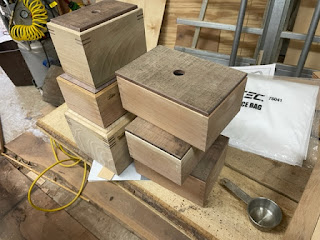
In the wood shop I've been finishing boxes that were started as demonstration boxes for teaching. Get them finished well and get them out of here! It's part of my plan to simplify.

Make, fix and create...


Wednesday, January 5, 2022

the hidden spline joint

Fine Woodworking has offered a free video online taken from my Basic Box Making DVD. It shows how to make a hidden spline box joint and covers the construction of the necessary jig. It should be useful to anyone with a love of making boxes.

Make, fix and create...  

Wednesday, August 25, 2021

oiling boxes

 I've been applying danish oil to boxes as you can see in the photo. The 20 boxes were made during the late spring and early summer but waited patiently while I sanded them and got them ready for finish. 

The finish used is inspired by the Sam Maloof formula that you can mix yourself. Mix 2 parts oil based polyurethane, one part boiled linseed oil and one part mineral spirits. The finish can be mixed in small batches and is relatively inexpensive to mix up. I use a plastic container that has ounce markings on the side. I pour in polyurethane from the can, up to the ten ounce mark, then linseed oil up to the fifteen ounce mark and then top off with mineral spirits to the 20 ounce mark. 

One advantage of this finish is that it can be wiped on and rubbed out to a pleasant sheen. It requires two coats. Another advantage is that it smells OK. And if you are going to work with a finish, you'll want it to be pleasant to the nose as well as to the hands. 

But what about the hands? You can wear rubber gloves if you like, or use sawdust to scrub the oil off your hands before washing with soap and water. In a wood shop sawdust is in abundant supply and readily absorbs oil from oily hands.

Make, fix and create...


Saturday, March 17, 2018

prices for boxes???

I got an inquiry from a reader and box maker who wonders how to price the boxes he makes. If you are inclined to sell your work there are many things to take into consideration, and I cannot make suggestions on the suggested price of an individual craftsman's work.

Is it one of a kind, or have you made an attempt to produce larger quantities? Of course boxes efficiently made can be sold at a lower price than your first box in which all your learning was required.

What is the quality of the box you've made? Will it hold up through time? Is it finely finished? What are its unique features? What woods are you using? Does it tell a story that resonates with the folks it comes into contact with?

Where and how are you trying to sell your work? Is it in a gallery or museum store? Or at your local farmer's market? Are you selling wholesale, or direct to customers? Is your time worth something as you sit in a craft show booth attempting to sell your work?

A good strategy is to consider the cost of the materials, the cost of overhead, and the cost of time. Then take into consideration, the cost of selling your work. Even if you are selling wholesale and are not selling direct to customers, there are costs involved. Even if you are selling your work to customers directly through craft shows, there are direct and indirect costs that affect the bottom line on box pricing.

The wisest words on all this are from Otto Salomon, early proponent of Educational Sloyd. He said that the value of the carpenter's work is in the usefulness of the object the carpenter makes. The value of the student's work, on the other hand, is in the student. It is in the growth of character and intelligence of the individual involved. It may make sense from that standpoint, to not worry about selling work, and to bask in the other benefits box making can provide.

Many box makers give their work to those they love. It is a simple thing that pays greatly.
the boxes in the photo are mitered finger-jointed boxes. The finger joints were formed using the new Leigh Box Joint and Beehive Jig that routs both 1/2 in. and 3/4 in. finger joints.


Tuesday, February 13, 2018

mitered finger joints...

I have an article on making mitered finger joints on the Finewoodworking.com website at this link:
http://www.finewoodworking.com/2017/12/07/make-mitered-finger-joints

The mitered finger joint is an interesting technique that allows the use of inlaid bandings on the top edge of a box. It also offers a slightly cleaner look to the top edge of a box and allows the cutting of grooves for floating panels to fit, using the table saw instead of the router.

Please watch for my article on Box Joints Made Easy in the current issue (April 2018) of Fine Woodworking.