Tuesday, May 5, 2026

Questions about resawing

Reader Karl wanted to know the best sequence for resawing wood. If you have a board that's 3/4 inches thick you would never want to waste most of it to get thinner sides. You might want to cut it right down the middle on the bandsaw or table saw and come up with two pieces that can be used to create smaller box sides. As an option you might choose to cut 1/2 inch from one side to come up with thicker wood leaving a remaining piece useful for other things like dividers or inlay. 

Turning most of a board into waste is seldom advised. When resawing always plan to plane the material after sawing. This will assure that the parts are uniform in thickness. So in resawing whether on the table saw or bandsaw,  a 1/2 inch board usually planes down to about 3/8 inch so the loss on each side of up to 1/16 inch will likely be required.

Say you want to make a box. The lengths of the sides and ends all added together plus 1 inch for waste saw kerf between parts as the side and ends are formed. Carefully check the ends of the stock for splits and checks and take that waste material into consideration as you calculate necessary length

For resawing on the table saw I recommend a thin kerf ripping blade as it will result in less waste and greater power in the saw.


Friday, August 15, 2025

Mitered finger joint

As part of my ongoing effort to finish unfinished products in my shop, I am making a box to fit a lid crafted during the filming of my book,  The Taunton Complete Illustrated Guide to Box Making. https://amzn.to/4mJiHWm  It involves the use of shop made inlay. The box is made with a mitered finger joint, also illustrated in the book.


Make, fix and create.

..


Friday, August 1, 2025

Drawer box complete

I finished the drawer support box, but for a bit of sanding and routing, so it is now ready for me to make a dovetailed drawer.

I will use my moxon vise to hold the stock as half-blind dovetails are cut by hand. There is satisfaction in it.

Make, fix and create...
 

Tuesday, July 29, 2025

an answer to too much glue

Reader's must have had experience, as have I, in spreading too much glue or in having tiny and precise applicators plug up and require laborious cleaning. 

The answer can be found in Kindergarten. The Kindergarten plastic glue spreader is available in mass quantities from Amazon https://amzn.to/4monpcd

Buy in whatever quantities you want, knowing that even with the strongest glue that it comes off and you can use again. I bought enough to share with students and friends. https://amzn.to/3IOwRae

Spreading glue for linings in the photo, I laid a bead of glue with a conventional glue bottle, then used the spreader to move some of the glue into corners. Easy. And avoids a mess.

Make, fix and create...


Friday, July 25, 2025

A tower of boxes...

 There is a heatwave in Northwest Arkansas, and the AC in the shop is having trouble keeping up. As an alternate to keep my hands busy, I'm finishing a few remnants from earlier projects in the finish area (one end of the house). 


This is a tower of boxes left over from my book Beautiful Boxes, Design and Technique published in 2014. It is held together by rare earth magnets.

Make,  fix and create...

Sunday, July 13, 2025

testing Glancy's No. 1

  This is a test of Glancy's No. 1 Penetrating Oil Finish.

Friday, July 11, 2025

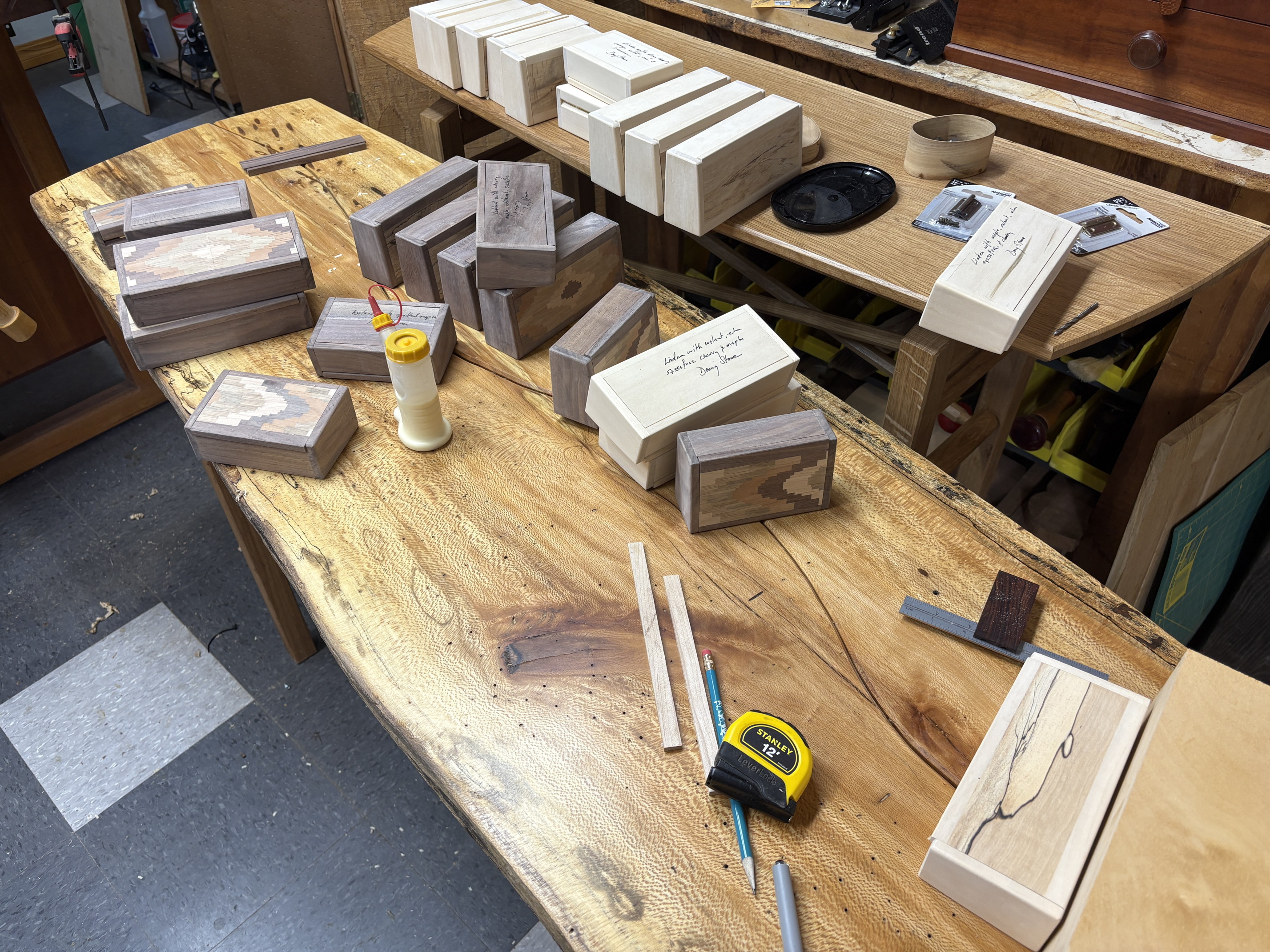
time to sign boxes...

In days past one could tell the species of wood being cut by the sound of the axe, even at a distance through the forest. Not so, now, so we go to more extreme efforts to get folks acquainted with the beauty and diversity of our native woods. 

I sign the names of the woods used in making my small inlaid boxes on the underside, helping folks now and in future generations to thus know that the woods have taken part in the creation as much as I. 

Each box is a collection of natural woods in natural colors and a gift to subsequent generations.

It's time to sign boxes.

Make, fix and create...